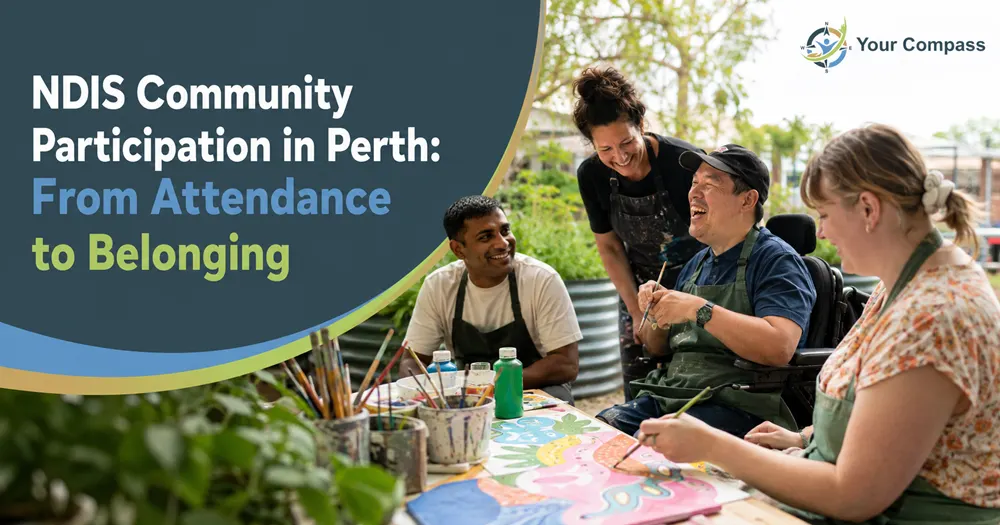
Being present in the community is not always the same as feeling part of it. A person can attend an activity every week and still have little opportunity to make choices, build relationships or become more confident.
Meaningful NDIS community participation in Perth starts with the individual: their interests, communication style, strengths, goals and preferred pace. The activity is only one part of the experience. The real value lies in what the person can practise, contribute, enjoy and carry into the rest of their life.
That is the difference between simply filling time and creating a pathway to belonging.
What is NDIS social and community participation?
Social and community participation supports can help eligible participants become involved in activities, groups and events. Depending on a person’s approved plan and goals, support may involve assistance to attend an activity, build social skills, navigate an unfamiliar environment or become more independent in the community.
The NDIS describes community participation funding as support that may help people connect with others in their area, join activities that interest them, develop social skills, build networks and increase independence.
Activities might include:
joining a local art, music or cooking class;
participating in sport or accessible recreation;
visiting a library, neighbourhood centre or community event;
trying a hobby group connected to a personal interest;
volunteering for a local organisation or cause;
developing confidence with shopping or everyday community tasks;
exploring study, work-readiness or skills-building opportunities;
practising communication and decision-making in real situations.
Funding does not automatically cover the ordinary cost of every activity, such as a standard ticket, meal or membership fee. What can be claimed depends on the participant’s plan, the type of support and current NDIS rules. Clarify inclusions before booking.
Attendance is an event; participation is an outcome
A standard activity calendar can be convenient, but it should not replace individual choice. Two people attending the same event may want completely different things from it.
One person may want to practise ordering independently at a café. Another may be working on feeling comfortable in a small group. Someone else may want to meet people who share a love of gardening, gaming, animals or music.
An interest-led approach asks better questions:
What would you genuinely look forward to doing?
Would you prefer one-to-one support, a small group or a larger setting?
What would make the activity feel safe and accessible?
Is there a skill you want to practise while you are there?
Would you like to meet people with similar interests?
What level of support helps without taking over?
How will we know the experience is helping you move towards your goal?
These questions turn an outing into a purposeful, participant-led opportunity.
How personalised participation can build independence
Confidence through repeated success
New places and social situations can feel uncertain. A support worker can help plan what to expect, identify quiet spaces, prepare communication tools and break the experience into manageable steps. As familiarity grows, the participant may choose to complete more parts of the activity independently.
Progress does not need to look dramatic. Entering a new venue, greeting a group member, making one decision or staying a little longer can all be meaningful steps when they relate to the person’s goal.
Practical skills in real environments
Community settings offer opportunities to apply skills where they will actually be used. A participant might practise reading a bus timetable, managing a small purchase, following a class routine, asking for assistance or planning what to bring.
This kind of learning can feel more relevant than practising the same task in isolation because the person can see its immediate purpose.
Relationships built around shared interests
Friendship cannot be manufactured, but the conditions for connection can be improved. Repeated participation in a mainstream club, class, volunteer role or neighbourhood group creates opportunities to see familiar faces and contribute around a shared interest.
The support worker’s role should not dominate the interaction. Where appropriate, they can help start a conversation, interpret communication or reduce barriers, then step back so natural relationships have room to develop.
A stronger sense of identity and contribution
People are more than recipients of support. Community participation can create space to be a teammate, artist, volunteer, student, club member, neighbour or mentor. Contributing to a group can strengthen confidence and help other community members recognise the person’s interests and capabilities.
What does good community support look like?
Quality support is active, adaptable and respectful. It should reflect what the participant wants from the experience rather than what is easiest for a provider to schedule.
A thoughtful approach includes:
Listening first. The participant’s interests, dislikes, routines, culture, communication and sensory preferences shape the plan.
Checking accessibility. Transport, mobility access, toilets, noise, crowds, timing, cost and communication barriers are considered in advance.
Agreeing on the support role. The participant decides when they want prompting, physical assistance, advocacy, companionship or space.
Building skills gradually. Support is adjusted as confidence grows rather than assuming the person will always need the same level of help.
Reviewing outcomes. The team talks about what was enjoyable, what was difficult and what the participant wants to try next.
The foundations that make participation possible
Community participation does not happen in isolation. Research published by the NDIA has highlighted the importance of foundations such as stable housing, adequate rest, health, individualised support and accessible transport.
For some participants, a successful community day begins with help preparing at home. Household task support may help maintain a safe environment and establish routines around meals, clothing and organisation. Assisted travel and transport can provide a reliable way to reach activities or help build confidence using public transport.
When these supports work together, the participant has a better chance to arrive prepared, take part meaningfully and return home safely.
Questions to ask a community participation provider
Before choosing a provider, consider asking:
How will you learn about my interests and goals?
Can support begin one-to-one before moving into a group?
Do I choose the activities, or must I follow a set calendar?
How do you match participants and support workers?
Can you support communication, mobility or sensory requirements?
How do you assess activity and transport risks with me?
Will you help me connect with mainstream Perth groups and opportunities?
How will we review progress without reducing everything to attendance?
What costs are covered by my plan, and what might I need to pay personally?
What happens if an activity is not a good fit?
The Registered NDIS provider should welcome these questions. You are choosing a partner for experiences that may be personal, unfamiliar and important to your goals.
Community participation shaped around you
Your Compass provides Innovative Community Participation in Perth with an emphasis on interests, skill-building and genuine local connection. Rather than treating community access as transport to a generic activity, we work with you to explore opportunities that reflect what you enjoy and what you want to achieve.
Support can be tailored to your comfort level and may include individual or group participation. Whether you want to try a creative class, volunteer, join a local club, expand your social network or become more confident in unfamiliar settings, the direction begins with you.
Find your place in the Perth community
Belonging develops over time through choice, familiarity, contribution and relationships. With the right support, community participation can become more than an appointment in the weekly schedule. It can be a practical route to confidence, independence and a richer everyday life.
Ready to explore an activity or goal that matters to you? Contact Your Compass to discuss personalised community participation support in Perth.
General information only. NDIS funding and purchasing rules depend on the participant’s approved plan and current NDIS requirements. Check your plan or speak with your my NDIS contact before purchasing a support.